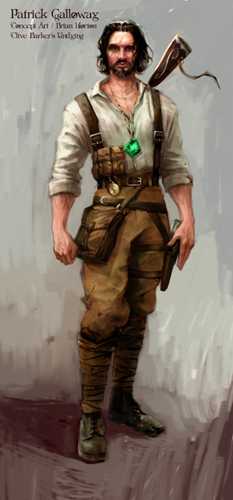
Wandering around trying to find info on the new Clive Barker book, The Scarlet Gospels (current word has it it may not be ready for another couple of years. Blast!) when I came across this fantastic quote about The Undying, a PC game he was closely involved with a few years back:
"We had this fellow called Magnus. Count Magnus Wolfram. Who was bald, tattoed, looked like a comic book hero. And I got them all in a room, and I said, 'Look, does anyone in this room know a count? No. Does anybody in this room know anybody called Magnus? No. Does anybody really want to be in this guy's skin? Since this is a first person play, why would you want to be in this man's skin? Why would you want to play [as him]?' And so we threw him out, and I said, 'Look. You've got a gay man in charge here. Bring me somebody I want to sleep with. Bring me somebody fabulously sexy.'...
"Brian Horton about ten days later sent me the character that now appears on the screen. Who was wonderful, he's everything I wanted. He was just the right kind of character. He seemed like somebody you would want to be, somebody you would want to play, whose skin you would want to occupy for a period of time. Even if you are going against the hordes of hell, at least he was going to do it with a smile on his face."
Makes a nice change from the 'Immortal Bald Man In Box Armour, Also Tits McGee' design aesthetic present in virtually every game today. Unless they're following the same design principal. In which case, eww...
Friday, May 15


Sunday, May 10
That 70s Show Season 1-6
153 24-minute episodes
When I was in high school, there were two shows I used to follow religiously. One was Buffy the Vampire Slayer, the other was That 70s Show. The timing of both was uncanny, since they were both lined up with my own high school experiences. Okay, so I wasn't fighting vampires and demons on a nightly basis, and I didn't exactly live next door to a hot redheaded neighbour girl, but everything else? Spot on.
The show centres around Eric Foreman, resident of the town of Point Place, Wisconsin, and the, generally dumb things he and his friends get up to in (wait for it) the 1970s. As set-ups go, that's all you need, and placing it in the 1970s ensures you don't get any unfortunate dated pop culture references, the bane of any show that trys to be 'modern'. Sure, you're looking smart by talking about the latest big band now, but give it six months, and you'reprobably going to look just a little bit silly.
The first two seasons are as sharp as you could hope for. The dialogue is often hilarious and the cast deliver it with spot-on timing. It's hard not to like the cast, from Kelso's idiocy, to Hyde's repeated manifestos about his distrust of The Man, a trait that sadly gets phased out as the series progresses. If the show doesn't remind you of someone you knew as a kid, or something you did, you probably should've done more.
THe one failing of the show is the same one that all sitcoms go through - complacency. Eric and Donna remain much the same from the first to the last, but all the other characters wind up being identified by their character traits more than anything: Red threatens to put his foot in someone's ass roughly three times a second, to the point where they start to throw it in if they can't think of a punchline. Kelso, prone to moments of insight and actual intelligence at times, is made the living avatar of Derp pretty swiftly, amd Jackie... well, she was always meant to be annoying, abrasive and irritating, so it'd be hard to have her devolve into a one-note character.
On the whole, though, the series is still damn funny - it must be, or I wouldn't have watched six seasons of it back to back over the course of about 5 days. Watching it reminded me of all the stupid crap we used to get up to in school, sitting around, talking absolute bollocks while listening to music, deciding we were going to conquer the world before the age of 21. The show manages to capture that feeling perfectly, even though half the cast are over the age of 25 by the third season. Yeah, the show's trading on nostalgia in a way, but sometimes, that's a good thing. Watch the first season at the very least, try to pretend the last season didn't happen. Blonde Donna... what the hell were they thinking?!
153 24-minute episodes
When I was in high school, there were two shows I used to follow religiously. One was Buffy the Vampire Slayer, the other was That 70s Show. The timing of both was uncanny, since they were both lined up with my own high school experiences. Okay, so I wasn't fighting vampires and demons on a nightly basis, and I didn't exactly live next door to a hot redheaded neighbour girl, but everything else? Spot on.
The show centres around Eric Foreman, resident of the town of Point Place, Wisconsin, and the, generally dumb things he and his friends get up to in (wait for it) the 1970s. As set-ups go, that's all you need, and placing it in the 1970s ensures you don't get any unfortunate dated pop culture references, the bane of any show that trys to be 'modern'. Sure, you're looking smart by talking about the latest big band now, but give it six months, and you'reprobably going to look just a little bit silly.
The first two seasons are as sharp as you could hope for. The dialogue is often hilarious and the cast deliver it with spot-on timing. It's hard not to like the cast, from Kelso's idiocy, to Hyde's repeated manifestos about his distrust of The Man, a trait that sadly gets phased out as the series progresses. If the show doesn't remind you of someone you knew as a kid, or something you did, you probably should've done more.
THe one failing of the show is the same one that all sitcoms go through - complacency. Eric and Donna remain much the same from the first to the last, but all the other characters wind up being identified by their character traits more than anything: Red threatens to put his foot in someone's ass roughly three times a second, to the point where they start to throw it in if they can't think of a punchline. Kelso, prone to moments of insight and actual intelligence at times, is made the living avatar of Derp pretty swiftly, amd Jackie... well, she was always meant to be annoying, abrasive and irritating, so it'd be hard to have her devolve into a one-note character.
On the whole, though, the series is still damn funny - it must be, or I wouldn't have watched six seasons of it back to back over the course of about 5 days. Watching it reminded me of all the stupid crap we used to get up to in school, sitting around, talking absolute bollocks while listening to music, deciding we were going to conquer the world before the age of 21. The show manages to capture that feeling perfectly, even though half the cast are over the age of 25 by the third season. Yeah, the show's trading on nostalgia in a way, but sometimes, that's a good thing. Watch the first season at the very least, try to pretend the last season didn't happen. Blonde Donna... what the hell were they thinking?!
Friday, May 1
Charles Stross - The Atrocity Archives
319 pages
Charles Stross likes science. You can tell this because the amount of jargon present in this book is staggering. Charles Stross also likes the Cthulhu Mythos. You can tell this because he once wrote a story where the US weaponized the Big C himself. Rule of Cool full in effect, y'all. The Atrocity Archives is the first in a series dealing with Bob Howard, employee of The Laundry. The Laundry are your typical Spookshow beyond-top-secret shadowy government department specialising in Weird Shit in all its forms. Of course, this being set in Britain, things are a lot less glamourous than you'd hope, with nary an Agent J, Jakita Wagner or as much as a Scully in sight. Bob is about as low on the foodchain as you can get, having been forcibly recruited by the group when he nearly turned half his hometown into a hellish abyss, dicking around with mathematical formulae as a student. Bored with being the departmental bitch, thanks to a boss who relishes every opportunity to make his life misery, he jumps at an opportunity to spread his wings with some fieldwork. Needless to say, shit gets very real, very quickly, and a decades-old Nazi plot to win the Second World War is swiftly rearing its ugly head.
Stross comes from the same school of writing as Grant Morrison: throw enough ideas at the reader and some of them are bound to lodge in their head. As a result, the number of concepts you're introduced to are almost too dense to take in, and less time is spent on any of them than you'd like. Maybe I've been spoiled by writers like Frank Herbert and China Mieville lately, but when I'm being introduced to a new world with new rules, I like to have some clue of what I'm doing before the game starts. Stross' frantic pace doesn't help in this respect either, and with the overall shortness of the book (the first 5 pages are an unrelated introduction, the last 103 are a short story, afterword and glossery of acronyms and abbreviations), you find yourself wanting more. Another 150 pages or so to fully explain the theories and ideas - or at least the terminology - within would've helped immesurably. Still, it's interesting finding out exactly how the core of an atomic bomb goes boom.
What we've got though, is damn good stuff. Bob's flatmates, nicknamed Pinky and Brains also work for The Laundry and are known to take their work home with them, resulting in some great moments - Pinky's attempts to disprove the old omelette/shell-breaking axiom will stick in your mind if only for the outright weirdness of it all. The idea that Alan Turing, honorary Grandfather of Steampunk, developed a mathematical formula to basically summon demons and punch holes in the spaces between dimensions is wonderful (and begs to be used in an RPG campaign somewhere). And then there's the moon with Hitler's face carved onto it. Can't forget that one. The thing that strikes you is the mundanity of it all though. You're cheerfully dicking around with arcane weaponry, disarming nukes that may just give demonic forces the oomph they need to play merry hell (literally) with our edge of reality, but there's always the chance you'll get shitcanned for showing up late once too often, and the training courses are still as boring as ever, if a little more deadly than the norm.
The Atrocity Archives is a solid book that needs to learn to catch its breath. I haven't read any of Stross' other books yet, but if this is any indication of the rest of his lineup, it's well worth checking out.
319 pages
Charles Stross likes science. You can tell this because the amount of jargon present in this book is staggering. Charles Stross also likes the Cthulhu Mythos. You can tell this because he once wrote a story where the US weaponized the Big C himself. Rule of Cool full in effect, y'all. The Atrocity Archives is the first in a series dealing with Bob Howard, employee of The Laundry. The Laundry are your typical Spookshow beyond-top-secret shadowy government department specialising in Weird Shit in all its forms. Of course, this being set in Britain, things are a lot less glamourous than you'd hope, with nary an Agent J, Jakita Wagner or as much as a Scully in sight. Bob is about as low on the foodchain as you can get, having been forcibly recruited by the group when he nearly turned half his hometown into a hellish abyss, dicking around with mathematical formulae as a student. Bored with being the departmental bitch, thanks to a boss who relishes every opportunity to make his life misery, he jumps at an opportunity to spread his wings with some fieldwork. Needless to say, shit gets very real, very quickly, and a decades-old Nazi plot to win the Second World War is swiftly rearing its ugly head.
Stross comes from the same school of writing as Grant Morrison: throw enough ideas at the reader and some of them are bound to lodge in their head. As a result, the number of concepts you're introduced to are almost too dense to take in, and less time is spent on any of them than you'd like. Maybe I've been spoiled by writers like Frank Herbert and China Mieville lately, but when I'm being introduced to a new world with new rules, I like to have some clue of what I'm doing before the game starts. Stross' frantic pace doesn't help in this respect either, and with the overall shortness of the book (the first 5 pages are an unrelated introduction, the last 103 are a short story, afterword and glossery of acronyms and abbreviations), you find yourself wanting more. Another 150 pages or so to fully explain the theories and ideas - or at least the terminology - within would've helped immesurably. Still, it's interesting finding out exactly how the core of an atomic bomb goes boom.
What we've got though, is damn good stuff. Bob's flatmates, nicknamed Pinky and Brains also work for The Laundry and are known to take their work home with them, resulting in some great moments - Pinky's attempts to disprove the old omelette/shell-breaking axiom will stick in your mind if only for the outright weirdness of it all. The idea that Alan Turing, honorary Grandfather of Steampunk, developed a mathematical formula to basically summon demons and punch holes in the spaces between dimensions is wonderful (and begs to be used in an RPG campaign somewhere). And then there's the moon with Hitler's face carved onto it. Can't forget that one. The thing that strikes you is the mundanity of it all though. You're cheerfully dicking around with arcane weaponry, disarming nukes that may just give demonic forces the oomph they need to play merry hell (literally) with our edge of reality, but there's always the chance you'll get shitcanned for showing up late once too often, and the training courses are still as boring as ever, if a little more deadly than the norm.
The Atrocity Archives is a solid book that needs to learn to catch its breath. I haven't read any of Stross' other books yet, but if this is any indication of the rest of his lineup, it's well worth checking out.
Wednesday, April 29
The Butterfly Effect - Director's Cut
115 minutes
If you know me, you know that love my mindfuckery. Seriously, I thrive on the stuff. Nothing better than a movie that plays with the audience, twisting their perceptions, forcing you to re-evaluate the entire plot, or a film with a storyline twisted like a coiled rope. Welcome then, to The Butterfly Effect, a film best described as Quantum Leap's troubled younger sibling.
Ashton Kutcher, better known for his part inDemi Moore That 70's Show plays Evan Treborn. As a boy, he suffers from frequent unexplained blackouts. His father suffered from the same blackouts, resulting in his being committed to a mental asylum. He is encouraged to keep a journal to try and jog his memories of these episodes. While going through them as an adult, he finds he is able to travel back to certain moments, enabling him to essentially redo or retcon moments of his life. When his childhood sweetheart commits suicide after he asks her about some of the abuse she suffered at the hands of her father and brother, he tries to use this ability to set things right with his friends' lives. Of course, dicking around with the timestream, as we all should know by now, is a shortcut to fucking things up royally, and Evan's good intentions lead him to redoing the events over and over again, trying to make things 'perfect'.
The Butterfly Effect was Kutcher's first major dramatic role, and he handles it well. It's easy to think of the film as a vanity project, a vehicle solely to show off his range, especially since Kutcher himself stumped up the cash to produce it, but, contrary to expectations, it's a surprise to learn he can do drama as well as idiot comedy. Evan comes across as a likeable guy, and his frustrations as his good intentions keep tumbling down around his ears are believable. There's one moment where he seems to have achieved his goal of a perfect world - his sweetheart, Keyleigh, is fine and happy, her brother isn't a sadistic monster, having turned to Jesus Christ and his best friend, committed for an accident involving a stick of dynamite, is stable and in love with the girl of his dreams. Unfortunately, that girl is Keyleigh. And Evan's mother is dying of cancer. And he's got no arms. As he tells his mother he can fix everything, with a look halfway between hope, helplessness and insanity, you start to wonder how noble his goals actually are. His aim has been fulfilled - everyone's happy and bright, but it's not perfect enough, despite the fact that, considering some of the other realities included suicide, drug addiction and prison rape, this one is idilyc. IS the fact that his mother is dying his reasons for taking another trip back? Or is it that he didn't get the girl this time?
The storyline too, is solid, playing its cards close to its chest, revealing them at the right moments to greatest effect. The revelation of moments like the picture he drew as a child take on a whole new significance once you stop and realise exactly what the implications of that moment actually mean. And then there's the ending. The original version had a 'happily ever after' ending tacked on at the studio's insistence. Everyone involved went ballistic at the suggestion, as it flies in the face of the dark tone of the film. Unfortunately, the studio brought its foot down, and the movie was released with said crappy ending intact. It's weak, it's sappy, and it just feels wrong. It's be like if Fight Club ended with all the people from the Narrator's support groups coming in to stop him blowing shit up with the power of Love and Peace (oh, wait). The Director's Cut thankfully changes it back to the original ending, giving a horrific spin to a single throwaway line in the middle of the film. And dear God, it works. It's bleak in a way, oddly optimistic in another, but I guarantee you will remember it.
As it was originally released, The Butterfly Effect is a decent, but forgettable film. With the tweaks and additions, the Director's Cut is a fantastic film that hints of great things for Ashton Kutcher, both as an actor and a producer. If he knows to back a few more winners like this, he might just atone for leaving the cast of That 70's Show when it needed him most.
Topher Grace? Blonde Laura Prepon? Take notes. You two are still in the bad books.
115 minutes
If you know me, you know that love my mindfuckery. Seriously, I thrive on the stuff. Nothing better than a movie that plays with the audience, twisting their perceptions, forcing you to re-evaluate the entire plot, or a film with a storyline twisted like a coiled rope. Welcome then, to The Butterfly Effect, a film best described as Quantum Leap's troubled younger sibling.
Ashton Kutcher, better known for his part in
The Butterfly Effect was Kutcher's first major dramatic role, and he handles it well. It's easy to think of the film as a vanity project, a vehicle solely to show off his range, especially since Kutcher himself stumped up the cash to produce it, but, contrary to expectations, it's a surprise to learn he can do drama as well as idiot comedy. Evan comes across as a likeable guy, and his frustrations as his good intentions keep tumbling down around his ears are believable. There's one moment where he seems to have achieved his goal of a perfect world - his sweetheart, Keyleigh, is fine and happy, her brother isn't a sadistic monster, having turned to Jesus Christ and his best friend, committed for an accident involving a stick of dynamite, is stable and in love with the girl of his dreams. Unfortunately, that girl is Keyleigh. And Evan's mother is dying of cancer. And he's got no arms. As he tells his mother he can fix everything, with a look halfway between hope, helplessness and insanity, you start to wonder how noble his goals actually are. His aim has been fulfilled - everyone's happy and bright, but it's not perfect enough, despite the fact that, considering some of the other realities included suicide, drug addiction and prison rape, this one is idilyc. IS the fact that his mother is dying his reasons for taking another trip back? Or is it that he didn't get the girl this time?
The storyline too, is solid, playing its cards close to its chest, revealing them at the right moments to greatest effect. The revelation of moments like the picture he drew as a child take on a whole new significance once you stop and realise exactly what the implications of that moment actually mean. And then there's the ending. The original version had a 'happily ever after' ending tacked on at the studio's insistence. Everyone involved went ballistic at the suggestion, as it flies in the face of the dark tone of the film. Unfortunately, the studio brought its foot down, and the movie was released with said crappy ending intact. It's weak, it's sappy, and it just feels wrong. It's be like if Fight Club ended with all the people from the Narrator's support groups coming in to stop him blowing shit up with the power of Love and Peace (oh, wait). The Director's Cut thankfully changes it back to the original ending, giving a horrific spin to a single throwaway line in the middle of the film. And dear God, it works. It's bleak in a way, oddly optimistic in another, but I guarantee you will remember it.
As it was originally released, The Butterfly Effect is a decent, but forgettable film. With the tweaks and additions, the Director's Cut is a fantastic film that hints of great things for Ashton Kutcher, both as an actor and a producer. If he knows to back a few more winners like this, he might just atone for leaving the cast of That 70's Show when it needed him most.
Topher Grace? Blonde Laura Prepon? Take notes. You two are still in the bad books.
Tuesday, April 28
Neil Gaiman - The Graveyard Book
312 pages
The temptation to just write 'It's Gaiman, so you know it's going to be good' is a strong one, but I did that already with American Gods, and I don't think I can get away with using it more than once. Damn you, conscience!
The Graveyard Book is, by Gaiman's own admission, a loose attempt at a modern day reinterpretation of The Jungle Book (the original Rudyard Kipling version, as opposed to the Disney version which people are more than likely more familiar with). The story opens, as all the best children's stories do, with a murder, a family killed by the man Jack. Only the youngest of the family, a toddler, manages to escape, wandering down to the local graveyard, where he is taken in and cared for by the local residents - in this case, the ghosts of the dead interred in the graveyard. He is named Nobody - Bod for short - given the Freedom of the Graveyard and, as he grows, learns how to haunt, fade from sight, and about the night that took his family from him.
For a children's book, Gaiman spares none of the punches, as expected. Gaiman's always been a fan of the G.K. Chesterton quote about how all children know about the monsters that wait in the dark, biding their time, and how it is the duty of the writer to tell them that while they do exist, they can also always be beaten. There are dark things out there. Evil things. But never doubt for a second that with a little cunning and bravery (always the most important characteristics in the fairy tales of old) anything can be overcome. Even a night-gaunt can be a friend in times of trouble if you know the right words. Never once though, does he talk down to the audience. The text is simplified just enough to let younger readers follow along, but still retains the typical wit and sophistication we've grown to expect from Neil.
The book is laid out in episodic, almost self-contained fashion, each chapter building on the last. The fact that each chapter's also the perfect length for bedtime reading probably isn't entirely unintentional. As the story grows, we follow Bod, from a toddler, to a teenager. As with every Gaiman story, it's the details and touches that make the book a pleasure to read; learning how to deal with 400 years worth of changing customs and manners through the various dead people buried in the graveyard; werewolves calling themselves the Hounds of God, believing that they are charged with destroying evil wherever it is found; ghouls, having lost their memories, naming themselves after the titles of famous rulers and leaders (not the names - the titles) making their home in a city of wrong angles... it all adds detail upon detail to an already engaging storyline that, at its heart, deals with the rewards and tragedies of growing up
Everything comes together neatly at the end, as you realise everything has been relevant and leading up to the finale. Every weapon in Chekhov's Arsenal is fired, and evil receives its just rewards. There are still mysteries left unresolved, but they're the best kind, the ones that make you wonder about the greater world and what else might be out there. It ends, once again, in classic Gaiman fashion, on a bittersweet note. Friends are lost and the world moves on, but it's never the end for the people left behind. Bod, like Mowgli before him, leaves the comfort of his home to rejoin the rest of the world, scared, but stronger for it. This, along with the lesson about defeating the monster above, is something every child - and more than a few adults - should learn to remember more often. Gaiman is the kind of storyteller we all wish we could've had as a child. If you know any, do them a favour: introduce them to this book. They'll thank you for it someday.
312 pages
The temptation to just write 'It's Gaiman, so you know it's going to be good' is a strong one, but I did that already with American Gods, and I don't think I can get away with using it more than once. Damn you, conscience!
The Graveyard Book is, by Gaiman's own admission, a loose attempt at a modern day reinterpretation of The Jungle Book (the original Rudyard Kipling version, as opposed to the Disney version which people are more than likely more familiar with). The story opens, as all the best children's stories do, with a murder, a family killed by the man Jack. Only the youngest of the family, a toddler, manages to escape, wandering down to the local graveyard, where he is taken in and cared for by the local residents - in this case, the ghosts of the dead interred in the graveyard. He is named Nobody - Bod for short - given the Freedom of the Graveyard and, as he grows, learns how to haunt, fade from sight, and about the night that took his family from him.
For a children's book, Gaiman spares none of the punches, as expected. Gaiman's always been a fan of the G.K. Chesterton quote about how all children know about the monsters that wait in the dark, biding their time, and how it is the duty of the writer to tell them that while they do exist, they can also always be beaten. There are dark things out there. Evil things. But never doubt for a second that with a little cunning and bravery (always the most important characteristics in the fairy tales of old) anything can be overcome. Even a night-gaunt can be a friend in times of trouble if you know the right words. Never once though, does he talk down to the audience. The text is simplified just enough to let younger readers follow along, but still retains the typical wit and sophistication we've grown to expect from Neil.
The book is laid out in episodic, almost self-contained fashion, each chapter building on the last. The fact that each chapter's also the perfect length for bedtime reading probably isn't entirely unintentional. As the story grows, we follow Bod, from a toddler, to a teenager. As with every Gaiman story, it's the details and touches that make the book a pleasure to read; learning how to deal with 400 years worth of changing customs and manners through the various dead people buried in the graveyard; werewolves calling themselves the Hounds of God, believing that they are charged with destroying evil wherever it is found; ghouls, having lost their memories, naming themselves after the titles of famous rulers and leaders (not the names - the titles) making their home in a city of wrong angles... it all adds detail upon detail to an already engaging storyline that, at its heart, deals with the rewards and tragedies of growing up
Everything comes together neatly at the end, as you realise everything has been relevant and leading up to the finale. Every weapon in Chekhov's Arsenal is fired, and evil receives its just rewards. There are still mysteries left unresolved, but they're the best kind, the ones that make you wonder about the greater world and what else might be out there. It ends, once again, in classic Gaiman fashion, on a bittersweet note. Friends are lost and the world moves on, but it's never the end for the people left behind. Bod, like Mowgli before him, leaves the comfort of his home to rejoin the rest of the world, scared, but stronger for it. This, along with the lesson about defeating the monster above, is something every child - and more than a few adults - should learn to remember more often. Gaiman is the kind of storyteller we all wish we could've had as a child. If you know any, do them a favour: introduce them to this book. They'll thank you for it someday.
Friday, April 24
Robotech: The Macross Saga
36 22-minute episodes
Mention the name Macross to any decent old school anime fan and they'll probably be able to regale you with tales of the Itano Circus, the affectionate name for the show's trademark missile barrages, contrails filling the screen like so much silly string of death, and of songs so powerful, they could change the course of war. Mention the same name to a child of the 1980s... and they'll probably give you a blank stare that'd do a cow proud. Ask them about Robotech, on the other hand, and they'll probably launch into the same speech as the anime fan with as much enthusiasm and the same dewy-eyed middle-distance gaze.
Somehow, despite being both a long-term anime fan and having the misfortune to be born in the 1980s, I completely managed to miss this. I had a few large figures based on the Zentradi mecha, and I know I saw a few Minmay dolls in the early 90s, but the show was never shown on any British non-satalite TV channel. So while the toys were admittedly very cool, I had absolutely no connection to them beyond 'I dig giant robots'. So, when I saw the box set for the first arc of the Robotech series for £10, I figured it was probably worth picking up, if only for the sake of getting it.
A little background for those still unaware of the show: back in the 1980s, three (mostly) unrelated mech shows were edited together to make a larger show suitable for syndication on US TV, the end result being unlike anything else shown on kids TV at the time. Two of those shows - Southern Cross and Genesis Climber Mospeada - have been all but forgotten, but the third, Super Dimension Fortress Macross, has had a lasting appeal like few others, both in Japan and in the West, with regular updates every few years. The most recent series, Macross Frontier, was released in time to celebrate the original show's 25th anniversary. In Western terms, it's comparable to Transformers, a classic well-loved show that's never really gone away, as so many others have.
Note: the following is a review of Robotech, the rewritten and redubbed version of Macross. I would've reviewed the original, but there was no option on the discs to switch to the original version. Hell, there wasn't even any subtitles for the hearing impaired! So if mentions of 'Rick Hunter' or 'Protoculture' make you physically ill, you may wish to stop reading right about...
...now.
The story starts in the far of year of 1999. An alien battleship crashlands on Earth, and the governments of the world put aside their fighting to try and find out what it is, where it came from and if there's any neat tech that can be ganked from it. Ten years later, the original owners of the craft come looking for it, and are less than happy to see it's been appropriated by a lesser race. So in a First Contact manoeuvre that would do Kirk proud, they open fire on the ship and the city that has since sprung up around it. So, the Captain of the battleship, since renamed the SDF-1, does the smart thing and gets the fuck out of Dodgem activating the ship's as-yet untested warp engines. This gets them away from the immediate assault, but leaves them with two more problems: the first, is that they've accidentally transported the surrounding city with them, a human population to the tune of around 70,000 people. The second, and slightly more pressing issue, is that they've now ended up somewhere in the orbit of Pluto, facing the crew with a journey that will take them at least two years to make, all while under constant attack.
Picking any holes in Robotech feels almost needlessly cruel: yes, the animation's ropey at times, the dialogue's outright dumb and much of the characterisation boils down to 'I did it just 'cus' but when you consider the show's coming up on 30 years old, none of it's very surprising. We've been spoiled in recent years by more sophisticated artwork and storytelling - even your average weekly shonen series can routinely impress in both these days - so in those respects, there's no way in hell the show could even hope to compare. And that's before you consider that the show's a bastardisation of the original. With all in mind, it's hard to know where to start. So we'll start with probably the single most important character in the show: Minmay.
I hate her. Well, that's not true. I just really can't stand her. Minmay first meets Rick Hunter, the dashing male lead, after he almost demolishes her house with a Veritech, the show's transforming mech/fighter jet in the second episode, and I spent much of the remaining series wishing he had. After Macross City is rebuilt aboard the battleship, they hold a beauty contest to raise morale, with Minmay being the winner. She's swiftly catapulted to stardom, becoming an idol singer, then a psychological weapon against the zentradi. In this role, she excels, not just against the invading aliens, but also against the viewer, singing the most insidious earworms you'll encounter outside of Star Trek II: The Wrath of Kahn. Her songs are terrible, but catchier than anything I've encountered in some time. And she brings them out at every opportunity, no matter how inappropriate the situation, and there are some doozies. We're told repeatedly that she's lovely and wonderful and is capable of making even her enemies switch sides, blah blah, but if she's anything, she's the epitome of flightiness, stringing Rick along for the better part of four years, only really telling him she loves him when Lisa Hayes, the other main female lead, decides she likes him.
Then again, Rick and Lisa aren't that much better. He's a hot-headed pilot pining after two women, both of whom spend most of their time pining after another man (and when you consider that one of them's related to the guy in question, that gets a whole lot squickier). She's an officious wench who falls for Minmay's cousin because he reminds her of her last boyfriend who died on a mission. We're meant to believe all three of these people are wonderful and brave and blah blah blah, but from what we're shown, Minmay's an airheaded attention-whoring Pollyanna, Lisa's an arrogant stuck-up bitch hung up on someone or another the entire length of the show, and Rick's an idiot savant (with a heavy emphasis on the idiot part) who's good at flying but not much else. Really, for a show that lists the power of love as one of it's major themes, it frankly sucks at it. The worst offender is the romance between Max and Miria: he beats her at piloting, then at an arcade game, so the feisty warrior chick does the only reasonable thing and tries to knife him. Max, never accused of being the quickest plane in the hangar, then tells her she's pretty and asks her to marry him, at which point she loses her will to fight, her knife and her personality in swift order.
And then we have the music, because I don't feel I've gotten across precisely how bad it is. Don't get me wrong, the idea of music being so powerful it can swing te tide of a war? I get it. Hell, I believe it. Not to the extent that it's shown in the show (well...) but the idea that a piece of music can change things dramatically? The only people who couldn't believe that are the terminally cynical or the utterly soulless. And, contrary to what you may have heard, I'm not quite all the way there on either count. So yes, the concept, I'm utterly behind, 300%. Just... why in the name of Clapton's time-distorting appendages would you pick those songs?! They're terrible! Sure the actual song played during the key battle is probably the best of the bunch, but the rest makes me want to hunt down the reanimated corpse of Keith Richards and ask him if he'd mind using his powers as a level 25 lich to flay the writer and composer of the songs alive and force them to wear a suit made of lemons for the rest of their unnatural pain-filled lives.
Finally, there's the pacing. I can only look at the show from the perspective that it's the first third of an ongoing series. In that respect, the fact that the show just peters out after the end of the war between the Zentradi and Earth is understandable: it's not the end, since there's another 40 or so episodes still to go. By itself, however, it looks like they're just trying to drag it out another 10 episodes to fulfil some kind of contractual obligation. Nothing much of any consequence happens, beyond the last two major villains getting drunk, riding a mech into battle like a pony, then deciding to kamikaze the SDF-1. I hope the original series ended a little better than that, because it's sad watching any show flounder like that for so long.
So there you have it: a show that's a relic of it's time, incapable of standing proudly with its descendants, outclassed and outpaced by them at every turn.
And yet...
And yet, somehow, I couldn't stop myself from watching. Really. There have been a multitude of shows I've never been able to get past the first few episodes - sometimes barely even making it past the opening credits for some reason - that I have little doubt are probably better in every possible way. Why should it be that I get nowhere with them, yet I sit and finish all six discs of this over the course of a week? It's not because I actually paid for these discs, as anyone who knows my DVD buying habits can attest. And it's not because I was desperate to find something to do for this article: my original plan was to watch the first two seasons of Transformers Animated, something I'm about 6 episodes away from finishing. As ropey as the animation is, they took the smart decision to save the budget for the fight scenes, with the end result being stylish acrobatic dogfights, even if they do play fast and loose with the laws of physics all the freakin' time. The mech designs have never been bettered, as timeless and as classical as any Gundam, and the scope of the story, leaving aside the spotty execution, is still remarkable. Can you imagine watching this as a kid, getting to the episodes where the Zentradi directly attack the Earth, and seeing them wipe out 95% of the surface - and life! - on the planet in one go? With shots of people and cities being vaporised for good measure to boot! I think, when you get down to it, that's probably my main problem with the show - I came to it at the wrong time. As a kid, it would've fulfilled every craving I had for a cartoon - a series with continuity, where changes actually happen from one episode to another, where people actually die. Since the days of Babylon 5, these things aren't just common, they're virtually mandatory - networks won't even look at your show if you don't have some kind of year by year plan in mind. But back then, the only kind of shows that had any real continuity were soap operas, so seeing this in a cartoon? Mind blowing.
So there you really have it: A show that's probably better in its native language, but it doesn't matter because I'm just really bitter about being unable to watch it when I was a kid who would've enjoyed it infinitely more.
Hey, at least I'm honest about it.
36 22-minute episodes
Mention the name Macross to any decent old school anime fan and they'll probably be able to regale you with tales of the Itano Circus, the affectionate name for the show's trademark missile barrages, contrails filling the screen like so much silly string of death, and of songs so powerful, they could change the course of war. Mention the same name to a child of the 1980s... and they'll probably give you a blank stare that'd do a cow proud. Ask them about Robotech, on the other hand, and they'll probably launch into the same speech as the anime fan with as much enthusiasm and the same dewy-eyed middle-distance gaze.
Somehow, despite being both a long-term anime fan and having the misfortune to be born in the 1980s, I completely managed to miss this. I had a few large figures based on the Zentradi mecha, and I know I saw a few Minmay dolls in the early 90s, but the show was never shown on any British non-satalite TV channel. So while the toys were admittedly very cool, I had absolutely no connection to them beyond 'I dig giant robots'. So, when I saw the box set for the first arc of the Robotech series for £10, I figured it was probably worth picking up, if only for the sake of getting it.
A little background for those still unaware of the show: back in the 1980s, three (mostly) unrelated mech shows were edited together to make a larger show suitable for syndication on US TV, the end result being unlike anything else shown on kids TV at the time. Two of those shows - Southern Cross and Genesis Climber Mospeada - have been all but forgotten, but the third, Super Dimension Fortress Macross, has had a lasting appeal like few others, both in Japan and in the West, with regular updates every few years. The most recent series, Macross Frontier, was released in time to celebrate the original show's 25th anniversary. In Western terms, it's comparable to Transformers, a classic well-loved show that's never really gone away, as so many others have.
Note: the following is a review of Robotech, the rewritten and redubbed version of Macross. I would've reviewed the original, but there was no option on the discs to switch to the original version. Hell, there wasn't even any subtitles for the hearing impaired! So if mentions of 'Rick Hunter' or 'Protoculture' make you physically ill, you may wish to stop reading right about...
...now.
The story starts in the far of year of 1999. An alien battleship crashlands on Earth, and the governments of the world put aside their fighting to try and find out what it is, where it came from and if there's any neat tech that can be ganked from it. Ten years later, the original owners of the craft come looking for it, and are less than happy to see it's been appropriated by a lesser race. So in a First Contact manoeuvre that would do Kirk proud, they open fire on the ship and the city that has since sprung up around it. So, the Captain of the battleship, since renamed the SDF-1, does the smart thing and gets the fuck out of Dodgem activating the ship's as-yet untested warp engines. This gets them away from the immediate assault, but leaves them with two more problems: the first, is that they've accidentally transported the surrounding city with them, a human population to the tune of around 70,000 people. The second, and slightly more pressing issue, is that they've now ended up somewhere in the orbit of Pluto, facing the crew with a journey that will take them at least two years to make, all while under constant attack.
Picking any holes in Robotech feels almost needlessly cruel: yes, the animation's ropey at times, the dialogue's outright dumb and much of the characterisation boils down to 'I did it just 'cus' but when you consider the show's coming up on 30 years old, none of it's very surprising. We've been spoiled in recent years by more sophisticated artwork and storytelling - even your average weekly shonen series can routinely impress in both these days - so in those respects, there's no way in hell the show could even hope to compare. And that's before you consider that the show's a bastardisation of the original. With all in mind, it's hard to know where to start. So we'll start with probably the single most important character in the show: Minmay.
I hate her. Well, that's not true. I just really can't stand her. Minmay first meets Rick Hunter, the dashing male lead, after he almost demolishes her house with a Veritech, the show's transforming mech/fighter jet in the second episode, and I spent much of the remaining series wishing he had. After Macross City is rebuilt aboard the battleship, they hold a beauty contest to raise morale, with Minmay being the winner. She's swiftly catapulted to stardom, becoming an idol singer, then a psychological weapon against the zentradi. In this role, she excels, not just against the invading aliens, but also against the viewer, singing the most insidious earworms you'll encounter outside of Star Trek II: The Wrath of Kahn. Her songs are terrible, but catchier than anything I've encountered in some time. And she brings them out at every opportunity, no matter how inappropriate the situation, and there are some doozies. We're told repeatedly that she's lovely and wonderful and is capable of making even her enemies switch sides, blah blah, but if she's anything, she's the epitome of flightiness, stringing Rick along for the better part of four years, only really telling him she loves him when Lisa Hayes, the other main female lead, decides she likes him.
Then again, Rick and Lisa aren't that much better. He's a hot-headed pilot pining after two women, both of whom spend most of their time pining after another man (and when you consider that one of them's related to the guy in question, that gets a whole lot squickier). She's an officious wench who falls for Minmay's cousin because he reminds her of her last boyfriend who died on a mission. We're meant to believe all three of these people are wonderful and brave and blah blah blah, but from what we're shown, Minmay's an airheaded attention-whoring Pollyanna, Lisa's an arrogant stuck-up bitch hung up on someone or another the entire length of the show, and Rick's an idiot savant (with a heavy emphasis on the idiot part) who's good at flying but not much else. Really, for a show that lists the power of love as one of it's major themes, it frankly sucks at it. The worst offender is the romance between Max and Miria: he beats her at piloting, then at an arcade game, so the feisty warrior chick does the only reasonable thing and tries to knife him. Max, never accused of being the quickest plane in the hangar, then tells her she's pretty and asks her to marry him, at which point she loses her will to fight, her knife and her personality in swift order.
And then we have the music, because I don't feel I've gotten across precisely how bad it is. Don't get me wrong, the idea of music being so powerful it can swing te tide of a war? I get it. Hell, I believe it. Not to the extent that it's shown in the show (well...) but the idea that a piece of music can change things dramatically? The only people who couldn't believe that are the terminally cynical or the utterly soulless. And, contrary to what you may have heard, I'm not quite all the way there on either count. So yes, the concept, I'm utterly behind, 300%. Just... why in the name of Clapton's time-distorting appendages would you pick those songs?! They're terrible! Sure the actual song played during the key battle is probably the best of the bunch, but the rest makes me want to hunt down the reanimated corpse of Keith Richards and ask him if he'd mind using his powers as a level 25 lich to flay the writer and composer of the songs alive and force them to wear a suit made of lemons for the rest of their unnatural pain-filled lives.
Finally, there's the pacing. I can only look at the show from the perspective that it's the first third of an ongoing series. In that respect, the fact that the show just peters out after the end of the war between the Zentradi and Earth is understandable: it's not the end, since there's another 40 or so episodes still to go. By itself, however, it looks like they're just trying to drag it out another 10 episodes to fulfil some kind of contractual obligation. Nothing much of any consequence happens, beyond the last two major villains getting drunk, riding a mech into battle like a pony, then deciding to kamikaze the SDF-1. I hope the original series ended a little better than that, because it's sad watching any show flounder like that for so long.
So there you have it: a show that's a relic of it's time, incapable of standing proudly with its descendants, outclassed and outpaced by them at every turn.
And yet...
And yet, somehow, I couldn't stop myself from watching. Really. There have been a multitude of shows I've never been able to get past the first few episodes - sometimes barely even making it past the opening credits for some reason - that I have little doubt are probably better in every possible way. Why should it be that I get nowhere with them, yet I sit and finish all six discs of this over the course of a week? It's not because I actually paid for these discs, as anyone who knows my DVD buying habits can attest. And it's not because I was desperate to find something to do for this article: my original plan was to watch the first two seasons of Transformers Animated, something I'm about 6 episodes away from finishing. As ropey as the animation is, they took the smart decision to save the budget for the fight scenes, with the end result being stylish acrobatic dogfights, even if they do play fast and loose with the laws of physics all the freakin' time. The mech designs have never been bettered, as timeless and as classical as any Gundam, and the scope of the story, leaving aside the spotty execution, is still remarkable. Can you imagine watching this as a kid, getting to the episodes where the Zentradi directly attack the Earth, and seeing them wipe out 95% of the surface - and life! - on the planet in one go? With shots of people and cities being vaporised for good measure to boot! I think, when you get down to it, that's probably my main problem with the show - I came to it at the wrong time. As a kid, it would've fulfilled every craving I had for a cartoon - a series with continuity, where changes actually happen from one episode to another, where people actually die. Since the days of Babylon 5, these things aren't just common, they're virtually mandatory - networks won't even look at your show if you don't have some kind of year by year plan in mind. But back then, the only kind of shows that had any real continuity were soap operas, so seeing this in a cartoon? Mind blowing.
So there you really have it: A show that's probably better in its native language, but it doesn't matter because I'm just really bitter about being unable to watch it when I was a kid who would've enjoyed it infinitely more.
Hey, at least I'm honest about it.
Subscribe to:
Posts (Atom)

 Posts
Posts